
I love movies. Always have.
The problem is, movies don’t love me back. Not at our cinemas, anyway.
Every time my wife and I go to the cinema, the same scene plays out. The action picks up, I lean over and whisper: “What happened? What did he say? Who’s that?” I don’t know the characters yet. Haven’t memorized their voices. She’s trying to watch the film and enjoy it like everyone else, and at the same time she’s trying to explain things to me, but her explanations come in fragments because the pace is too fast. So neither of us gets the full experience.
Once, a woman turned to us and said: “Could we get some quiet, please? We’re trying to focus.” I was embarrassed. Genuinely. And she was completely within her right to ask. The problem wasn’t her. It wasn’t me either. It was the absence of a service that should’ve been there from day one.
What Is Audio Description?
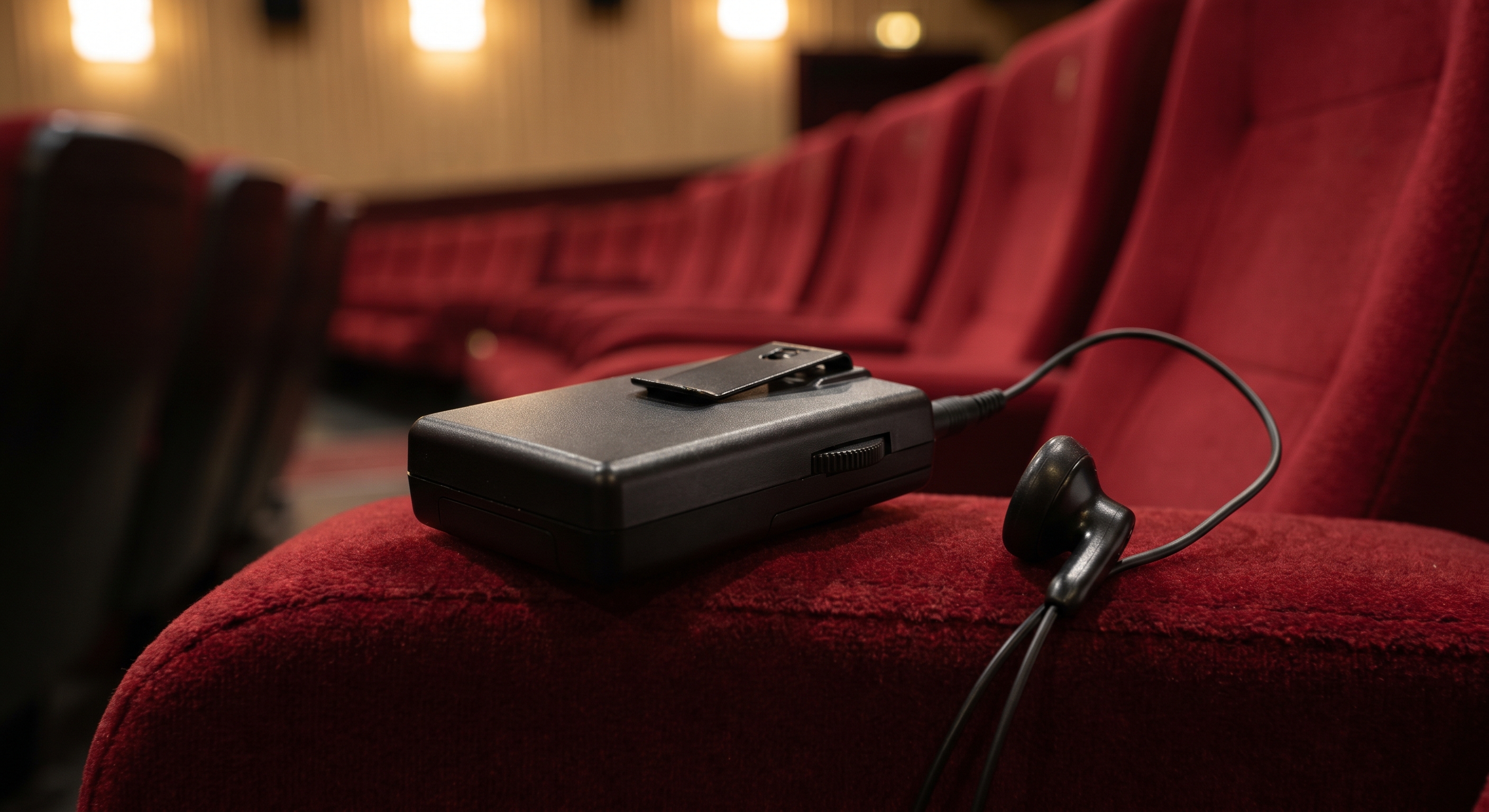
Audio description is an extra audio track layered into a film. A narrator describes what’s happening on screen during pauses in dialogue: character movements, facial expressions, scene changes, everything you can’t pick up from sound alone. You wear a single earpiece that plays the description while your other ear hears the original film audio. Full experience. Zero disturbance to anyone around you.
If you want to hear what it sounds like in practice, watch this clip from The Lion King with audio description on YouTube. You’ll get it immediately.
The Discovery
I discovered audio description in 2016, in college. Home Alone. I was laughing so hard at the sound effects and that scene where Kevin plays a clip from an old movie to scare the burglars. For the first time in my life, I understood everything. What was happening on screen, why people were laughing, what made a scene funny in the first place.
My English had finally gotten good enough that I didn’t need translations or someone summarizing beside me. A whole world opened up. I dropped some courses that semester because I was completely consumed by this new reality.
Five Blind Guys, One Overwhelmed Narrator
My first time in an actual cinema was 2018, in Bahrain. Five blind guys and one sighted friend who drove us there. The film was Esmat Abu Shanab, an Egyptian comedy. I asked the employee at the entrance: “Do you have audio description headsets?” He looked at me like I was speaking a different language.
Picture this: five blind people huddled around one sighted person, and he can’t decide whether to watch the movie or describe it to us. In one scene, the theater went dead silent, then everyone burst out laughing. All we heard was a series of WhatsApp notification sounds. We turned to each other: “Who’s got their phone on?” Turned out the scene was text messages being exchanged on screen between two characters. The audience was reading and laughing. We couldn’t see a single word.
We laughed a lot that day. Not always at the movie, though.
Then I Went to America
In 2019, I traveled to Silicon Valley for an entrepreneurship program. I’d heard from American friends over the years that movie theaters have audio description headsets. So I went to Century 20 in Redwood City to see The Lego Movie 2.
Simple. Asked for a headset at the counter, got a small device with one earpiece. Sat down. The movie started, and so did the audio description.
I can’t describe what that felt like. To laugh at the exact same moment as everyone else in that theater, knowing exactly why you’re laughing. To follow every scene, every movement, every expression. I didn’t ask my friend “What happened?” once. Not once.
It was like I could see. I really could.
That song from the movie is still stuck in my head to this day.
Back to Reality
Cinemas reopened in Saudi Arabia in April 2018. First screening: Black Panther at AMC Riyadh. I was thrilled. I thought the experience would be complete.
It wasn’t. When I went to the cinema after getting married, I found no headsets, no audio description, no accommodations of any kind. Back to square one: whispering to my wife, “What happened?” She tries to juggle watching and explaining. People around us get annoyed by the constant whispering.
Every single time I leave a cinema, I ask: “Where are the audio description headsets?” The awareness is close to zero.
Why Doesn’t It Exist Here?
Here’s the absurd part. The technology isn’t complicated or expensive. Major studios like Universal and Warner Bros. include the audio description track in the Digital Cinema Package (DCP) they ship to theaters as part of the standard package. The track arrives with the film, ready to play. All the theater needs is headsets and the will to offer them.
In the US, the Americans with Disabilities Act (ADA) has required theaters to provide audio description since 2017. In Saudi Arabia, the Rights of Persons with Disabilities Law guarantees the right to access visual and audio content. But cinema operators and streaming platforms don’t comply, and there’s no clear enforcement mechanism yet.
Beyond cinemas, Arabic streaming platforms offer virtually no audio description. Even Disney+, which used to provide it on some films through OSN, has stopped for its Arabic content. One of the rare exceptions worth highlighting is Masameer, a Saudi animation studio that added Arabic audio description to their work on Netflix.
Culture Is Not a Luxury
I believe, deeply, that people build their understanding of the world through what they read, hear, and watch. As a kid, I relied on my siblings to describe what was happening in Spacetoon cartoons. What they didn’t describe, I tried to imagine from the sounds. But that approach doesn’t scale. Action movies with fast pacing are impossible to follow through a person sitting next to you. That’s why I’ve never been able to watch a Marvel film in a cinema. I wait for it to hit a streaming platform where audio description is available.
A Right, Not a Favor
Article 14 of Saudi Arabia’s Rights of Persons with Disabilities Law states: “Persons with disabilities have the right to access and benefit from content (written, visual, and audio).” Cinema is visual and audio content by definition. The absence of audio description isn’t a gap in service. It’s a violation of the law.
Close your eyes in a dark theater for two hours. Can you follow the story? Now imagine paying full ticket price for that experience. Every time.
In Saudi Arabia alone, nearly one million people live with visual impairment, 75% of them completely blind. Globally, 2.2 billion people have a vision impairment according to the World Health Organization. These aren’t statistics. These are people who want to watch a movie and laugh with everyone else at the same moment.
Audio description is not a courtesy. It’s not a nice-to-have. It’s a right, guaranteed by law, enabled by technology, and waiting only for the will to deliver it.
So when do we stop asking: “What happened?”
Comments
No comments yet.
Add a comment
Sign in to comment